Register
Joint IN-IMF-NI (India West) Seminar 2026
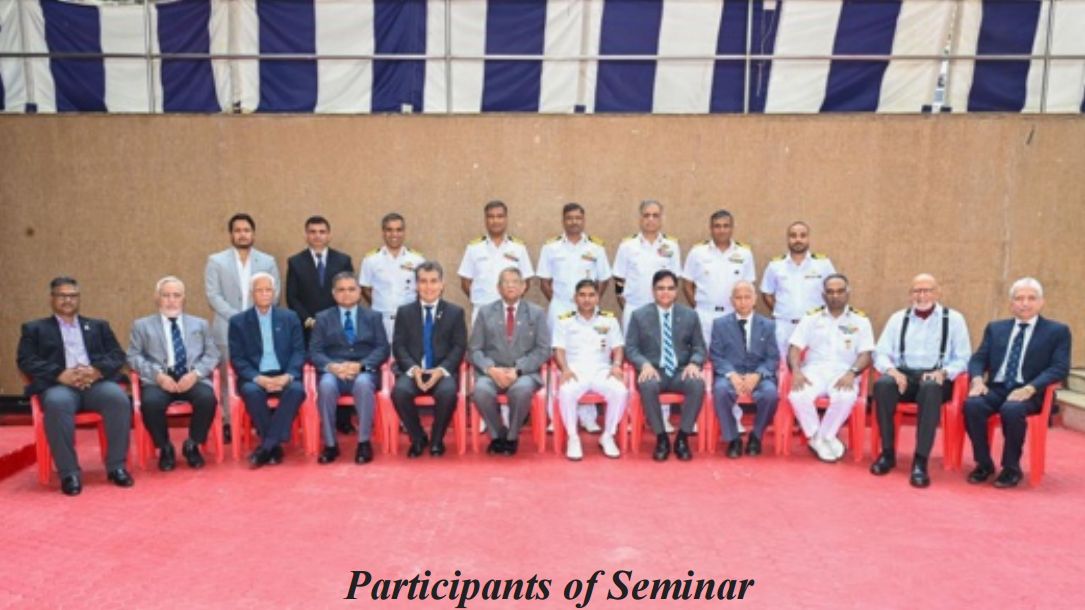
The 12th Edition of the Joint Indian Navy (IN)-Indian Maritime Foundation (IMF)-Nautical Institute (India West) (NI(IW) Seminar 2026, was hosted by the Headquarters Western Naval Command (HQWNC), at INHS Asvini, Mumbai on 30 September 2026. The Seminars conceived in 2012 by the late Cmde Rajan Vir, Founder President of IMF. He had the firm conviction that the Indian Navy and the Merchant Navy though operating in different roles, had much to learn from each other. The overarching theme for these-
seminars was and remains to be — Fostering Cooperation between Seafaring Communities. The title of this year’s Seminar was: Contemporary Trends in The Maritime Domain with Special Reference to the Persian Gulf War of 2026. Given the continuing conflict between The US and Iran on one side and Iran on the other, this was an area of common concern to all seafarers. The Seminar was conducted by the Maritime Warfare Centre Mumbai, under the aegis of HQWNC, and was divided into three Sessions — the Inaugural Session, followed by two Technical Sessions.
Inaugural Session
The Inaugural Session began with the Opening Address by Cmde Ajay Chitnis SC, NM (Retd.), President Indian Maritime Foundation. He welcomed all the delegates and began by tracing the evolution of these Seminars, and how we have reached the 12th Edition, maintaining the overall need to learn from each other’s experiences under
various situations, and especially during the current conflict that does not seem to be ending very soon. He stressed on the fact that Seafarers of all hues – Indian Navy, Merchant Navy, Indian Coast Guard, Fishermen, and all those who go to sea, backed up by the Maritime Administration, Maritime Rescue Coordination Centres,
International Information Fusion Centres; all have one common thread. And that is the Sea, which does not recognize any boundaries or colours of uniforms, and thus need to understand the need for cooperation between people. Cmde Chitnis cited a few recent incidents at sea to illustrate how the Cooperation between various agencies ashore and afloat had led to rescue of seafarers. He also highlighted the need to add Maritime Community Awareness to Maritime Domain Awareness knowledge of not only what is happening there, but who all are there, and how can we be of assistance. He also spoke briefly about the IMF, which was founded in 1993 by a
group of Retired Officers from the Indian Navy and Merchant Navy, with the main aim of helping Indians to realise their Maritime Identity.
This was followed by the Inaugural Address by Capt Zahrir Irani, Vice President Global of the Nautical Institute and President of the UAE Chapter of NI. He began by saying that he was literally in the War Zone, and seeing things as they unfold in the current energy and shipping crises caused by ongoing conflict. He said that it was a
matter of pride that an Indian national was the Vice President of Nautical Institute, and it was a just recognition of the contribution of Indian Seafarers to the Mercantile Marine worldwide. The address reviewed recent Indian Government advisories calling for heightened vigilance, controlled deployment, continuous monitoring, and prompt reporting of incidents involving Indian Seafarers. It also noted that several major Seafaring nations have adopted comparable measures focused on Crew Safety and Welfare. Key Message: Protecting Seafarers requires coordinated efforts among Governments, Shipping Companies and Maritime Professionals, with safety and security always taking precedence over commercial considerations.
Keynote Address was delivered by Cmde Asheem Mittal, Director M™WC. He highlighted the impact of the Gulf conflict on Merchant Vessels and Seafarers, including incidents involving Indian Crew members, and emphasized the need for greater International responsibility to ensure the safety of Maritime routes. He also stressed the
importance of maintaining the uninterrupted flow of global commerce and protecting Seafarers through coordinated Diplomatic, Security and Maritime efforts. He also shared the recent address by Mr. Jaishankar, External Affairs Minister (EAM) of India; where Dr. S. Jaishankar emphasized that the security of the Strait of Hormuz is critical to global trade and energy supplies. EAM had condemned attacks on commercial Vessels and Seafarers, called for stronger International cooperation to safeguard
Maritime routes, and stressed that the safety of Seafarers and the uninterrupted flow of Maritime commerce must remain a “Global priority”.
Session I -Maritime Trade, International Maritime Law and the impact of ongoing conflicts on global shipping.
Moderator: Capt Amit Deshpande, Secretary NI (IW)
Capt Varun Panicker IN, Commanding Officer INS Mormugao, the first speaker of this session, highlighted the increasing vulnerability of global maritime trade amid the Persian Gulf and Strait of Hormuz crisis. He emphasized that protecting merchant shipping requires continuous Maritime Domain Awareness, real-time information sharing, inter-agency coordination, and rapid response capabilities rather than relying solely on “Naval escorts”. Drawing on lessons from Operation Urja Suraksha, he underscored the Indian Navy’s role in safeguarding strategic energy supplies and ensuring the uninterrupted flow of maritime trade through persistent surveillance, information superiority, and coordinated security operations.
Cmde Professor Shrikant L. Deshmukh NM (Retd.) representing the Indian Maritime Foundation, the second speaker, emphasized that India’s economic growth, trade, and energy security are critically dependent on safe and uninterrupted maritime trade routes. He highlighted the increasing risks posed by geopolitical tensions, conflicts in key maritime chokepoints such as the Strait of Hormuz, Bab-el-Mandeb, and the South China Sea, as well as piracy and maritime crime. He stressed upon the need for India to strengthen Maritime Security, enhance supply chain resilience, diversify energy sources, reduce import dependence, and explore alternative trade routes to safeguard National interests in an increasingly uncertain “Global Environment”.
Captain Kapil Dev Bahl representing the Nautical Institute highlighted that the ongoing conflict in West Asia poses serious challenges to International Maritime trade, Maritime Law, and the Safety of Seafarers. Attacks on Commercial Shipping by both State and Non-State actors have disrupted global supply chains, increased
transportation costs, and challenged the principle of “Freedom of Navigation”. He emphasized that emerging threats from drones, missiles and unmanned vessels have exposed gaps in existing Maritime Legal frameworks. The presentation examined the impact of the conflict on Merchant Shipping and analysed the application of
UNCLOS provisions relating to innocent passage, transit passage, and navigation rights in “International Waterways”.
Session II – “Contemporary Trends in Maritime Domain impacting the Global Commons
Moderator: R Adm RJ Nadkarni AVSM, VSM (Retd.), Council Member, IMF
Cmde. M. Doraibabu NM, Addl Director Maritime History Society, kicked off Session II with a brilliant expose’ on the National Maritime Heritage Complex (NMHC), Lothal, and its role in preserving and showcasing India’s Rich Maritime Heritage. It traces maritime activities from the Indus Valley Civilization, emphasizing Lothal’s renowned 4,000-year-old Harappan tidal dock and the extensive trade networks connecting India with Mesopotamia, Central Asia, and the Persian Gulf. He also highlighted the importance of documenting Maritime history and explained how the NMHC, a large-scale heritage project in Gujarat, will provide immersive experiences through museums, galleries, research facilities and cultural attractions. A major focus is the evolution of India’s Naval power, covering historic Maritime Dynasties, European influence, the World Wars, Independence and the growth of the modern Indian Navy and Coast Guard, thereby bringing India’s Maritime legacy into greater public awareness.
Captain Kamalaksha V. Kamath, representing the Nautical Institute, discussed the Maritime industry’s transition from the legacy S-57 electronic Chart standard to the advanced S-100 Universal Hydrographic Data Model. He highlighted how S-100 enables the integration of enhanced navigation data, including charts, tides, currents, bathymetry and navigational warnings, leading to improved interoperability, voyage planning, Navigation Safety, and cybersecurity. The presentation emphasized the need for ECDIS upgrades, Crew training, and operational readiness to meet upcoming Regulatory requirements and fully realize the benefits of next-generation digital Navigation.
Ch Engr Atharva Kotwal, representing the Indian Maritime Foundation, presented the concept of Al-Driven Maritime Intelligence, highlighting how Artificial Intelligence can enhance maritime operations through improved decision-making, fuel optimization, engineering support, compliance verification and voyage management. He emphasized that AI should complement human expertise rather than replace it, with strong attention to cybersecurity, data governance and controlled implementation. The presentation concluded that the gradual adoption of AI can improve efficiency, reduce costs and errors, and support more sustainable Maritime operations while retaining human oversight of critical decisions.
Both Sessions saw lively QAs on conclusion of the speakers’ presentations, and were astutely managed by the Moderators, and they kept a strict control on the time management, leading to timely conclusion of the Seminar. The Vote of Thanks was delivered by Capt Abhijeet Jadhav of MWC Mumbai.
The Seminar was attended by about 250 participants, which included various dignitaries, Officers & Trainees from the Indian Navy, Merchant Navy and Members of the Indian Maritime Foundation. Attendees who turned out in large numbers included Senior Indian Navy Personnel, Representative from Director General of Shipping in India, Heads / Senior Management Members of some of the India’s Leading Ship Management Companies / Associations.
In conclusion, the Seminar underscored the importance of collaboration, innovation, and resilience in addressing contemporary Maritime challenges. From safeguarding Seafarers and securing critical trade routes to embracing digital transformation and preserving Maritime heritage, the discussions reaffirmed the need for a collective approach to ensure a safe, sustainable, and prosperous Maritime future.